The Evangelical Basis of Consecrated Life
A vow is a deliberate and free promise made to God concerning a possible and better good which must be fulfilled by reason of the virtue of religion. A religious institute is a society in which members, according to proper law, pronounce public vows and live a life in common. (From the Canon Law of the Catholic Church)
According to St. Thomas Aquinas, a vow is a natural act of worship of God. The evangelical counsels, when offered to God under vow, cause the very being and actions of the religious to become a living sacrifice, in conformity to that of Christ. By the grace of the vow, the individual receives the supernatural help to fulfill a commitment that lasts an entire lifetime. The vows fix the will of the religious in a stable way on the good of total self-giving to God.
The deepest meaning of the evangelical counsels is revealed when they are viewed in relation to the Holy Trinity, the source of holiness. They are in fact an expression of the love of the Son for the Father in the unity of the Holy Spirit. By virtue of their dedication lived in fullness and in joy, consecrated women are called in a very special way to be signs of God’s tender love toward the human race.
Consecrated Chastity
In a celibate state of life, Jesus Christ dedicated Himself entirely, freely, and with undivided love to the work of glorifying the Father and redeeming the world. Consecrated celibacy, like Christian marriage, stands as a profound sign and living expression of love. It binds us directly and intimately to the Lord, opens our hearts to His concerns, and enables us to be generous in our dedication to His mission and selfless in the service of others.
Therefore, like Christian marriage, consecrated celibacy is a possible, meaningful, and deeply satisfying way of life. It is a participation in the bridal mystery of the Church, a source of spiritual fecundity, and a visible sign of that wondrous marriage bond between the Church and Christ, her only Spouse—a union that will be fully revealed and perfected in the world to come.
In Mary, virginal love became abundantly fruitful in motherhood, not only because she bore the Savior into the world, but also because, through her loving cooperation with God’s will, the faithful are continually born and nurtured within the Church. With confidence and trust, we ask her to accompany and assist us as we strive to live our vow faithfully from day to day, in the strength, freedom, and joy of the Holy Spirit, so that our virginal love may bear lasting fruit for the Church in a spirit of spiritual motherhood.
Evangelical Poverty
Jesus freely assumed poverty in order by his poverty to make us rich (cf 2 Corinthians 8:9). When a person sells what she possesses and gives to the poor she discovers that those possessions and the comforts she enjoyed were not the treasure to hold on to. The treasure is in the heart, which Christ makes capable of giving to others by the giving of self. The rich person is not the one who possesses but the one who is able to give. Answering the Lord’s call, we leave home and possessions, bind ourselves by vow to evangelical poverty, and place ourselves and all our resources at the service of our mission. We observe poverty not for its own sake, but that it may make us and the goods of our community free and available. Our life of poverty acquires its deeper meaning and value when it leads us to poverty of spirit, which has no limit and allows us to accept consciously and with gratitude our creaturely dependence on God. Through our availability and openness to God and others and our humble recognition and acceptance of our limitations and weaknesses, which we thereby transcend, we attain to that joy promised in the Beatitudes.
Apostolic Obedience
Jesus came not to do his own will but his Father’s. Moved by the spirit of Love, he redeemed the world by his obedience even to accepting death on a cross. Obedience, practiced in imitation of Christ, shows the liberating beauty of a dependence which is not servile but filial, marked by a deep sense of responsibility and animated by mutual trust. In a spirit of faith and love, we place ourselves and our wills by vow at the service of God and of the community to which we were called. Individually and collectively, we seek to know and to fulfill God’s will and to realize the Lord’s obedience in our community in such a way that it can be a witness and example to others. With a sense of responsibility, we accept the duties entrusted to us and use our powers of understanding and will, as well as our gifts of nature and grace, in order to contribute to the upbuilding of the body of Christ.
Ave Sponse Coelestis
Hail Heavenly Spouse
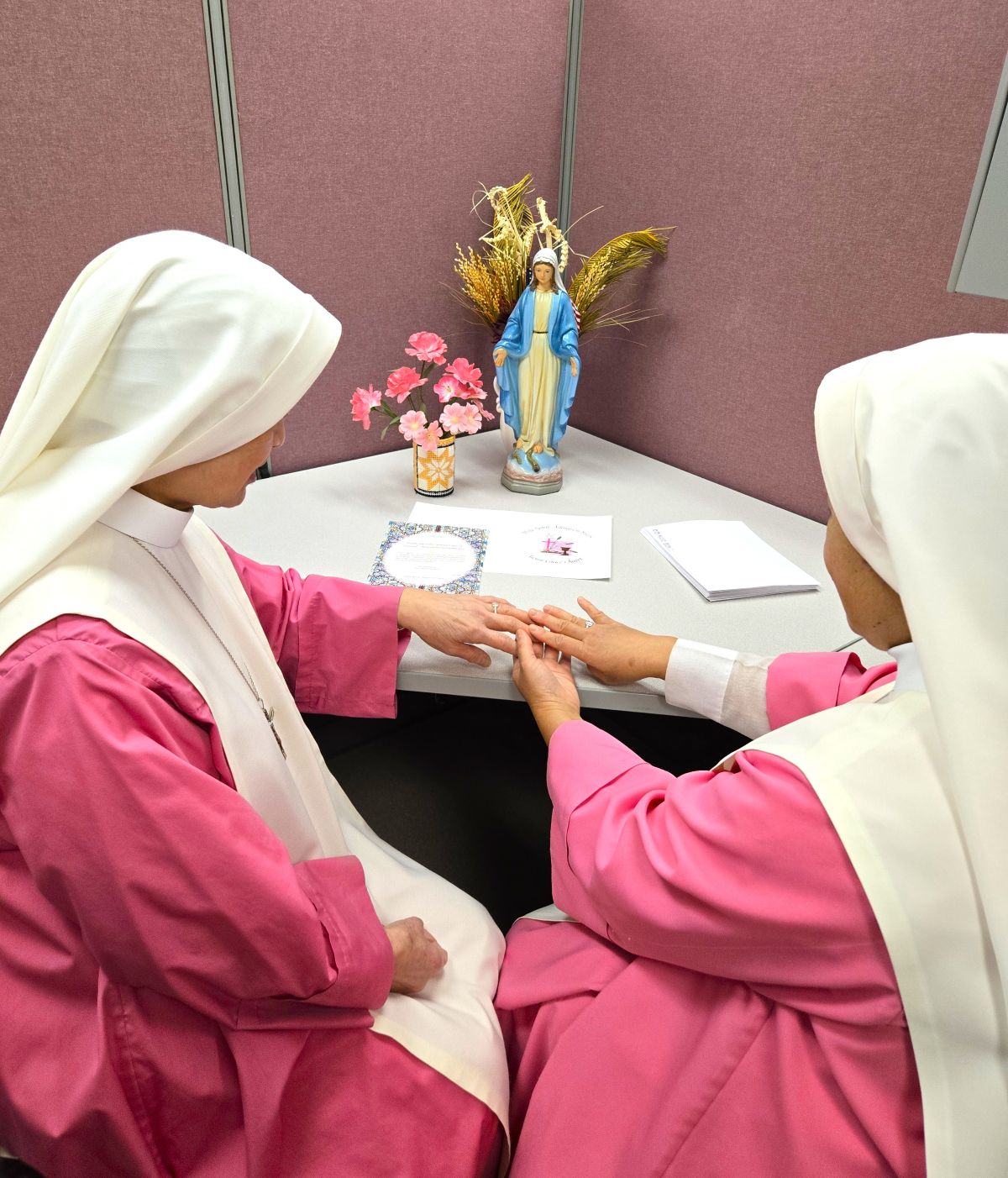
The betrothal ring that we receive at perpetual profession of vows bears a symbol of the Holy Spirit and the inscription Ave Sponse Coelestis (Hail, Heavenly Spouse). This dates all the way back to the very first perpetual profession in 1901, when the Adoration Sisters and Mission Sisters were still one Congregation, and is part of our spiritual tradition. For our Founder, St. Arnold Janssen, the thought of the Holy Spirit as Spouse was part of his spirituality from very early on. From his father he had inherited the veneration of the Holy Trinity and a special devotion to the Holy Spirit. In 1874, before he had founded his three Congregations, he wrote:
Over the years, veneration of the Holy Spirit took on more and more importance in St. Arnold’s life, so it was instinctive for him to name both of the Sister’s Congregations for the Holy Spirit. The co-foundresses of both the contemplative and active branches also brought the veneration of the Holy Spirit with them from home, and so the Sisters thus found it most natural to address the Holy Spirit as Thou, heavenly Spouse. The first Constitutions of 1891 (again, while both branches were still one Congregation) stated: Through their holy vows the Sisters are consecrated in a special way to God and become at the same time brides of Jesus Christ and of the Holy Spirit, whose special servants they are.
St. Arnold venerated Mary, the Mother of Jesus, as “Daughter of the eternal Father, Mother of the divine Son, and Spouse of the Holy Spirit.” Through her Fiat, Mary became the Spouse of the Holy Spirit and was, at the same time, the first servant of the Holy Spirit. Her Fiat made the incarnation of the Divine Word possible, the beginning of redemption through Jesus Christ. St. Arnold placed Mary as a model before his Servants of the Holy Spirit. It is clear that to be a servant of the Holy Spirit after the example of Mary is possible only in spousal dedication to the eternal Love, the Holy Spirit. Seen in this way, our name Servants of the Holy Spirit and the greeting on the profession ring Ave Sponse Coelestis are intimately connected.
For St. Arnold, his veneration of the Holy Spirit was a continuation of his intense veneration of the Sacred Heart of Jesus. Some of his expressions were “We hope that we receive a stream of graces of the Holy Spirit from the Heart of Jesus” and “Heart of Jesus, filled with the Holy Spirit!” The love of Jesus IS the Holy Spirit, and this connects our identity as a spouse of the Holy Spirit with the Church’s teaching that through the profession of the evangelical counsels the nun becomes a spouse of Christ.
The Church teaches that a marriage bond has three qualities: it is free, faithful, and fruitful. According to Pope John Paul II, A woman is ‘married’ either through the sacrament of marriage or spiritually through marriage to Christ. In both cases marriage signifies the ‘sincere gift of the person’ of the bride to the groom (Mulieris dignitatem). Spousal love is a total love of self-giving. The religious profession, springing from an interior encounter with the love of Christ and made as a free response to that love, creates a new bond between that person and the One and Triune God, in Jesus Christ. The religious is consecrated to God as his exclusive possession and through the evangelical counsels conforms her life to Christ: the chaste, poor, and obedient One. Virginal love becomes fruitful in the spiritual realm, through the power of the Holy Spirit. The evangelical ideal of virginity cannot be compared to remaining simply unmarried or single, because virginity is not restricted to a mere “no”, but contains a profound “yes” in the spousal order: the gift of self for love in a total and undivided manner.